Advocacy

Where we stand

We campaign on issues, not candidates. That keeps the club open to everyone and pointed at what actually matters — warrantless surveillance, the Fourth Amendment in the digital age, facial recognition, and the data-broker economy. Our work looks like explainer panels, Pennsylvania Right-to-Know requests, op-eds, and awareness campaigns, all non-partisan.

Surveillance accountability Fourth Amendment online Facial recognition Data brokers Encryption rights
Issues, not parties. We don't endorse candidates or political parties. We make the case on the merits and leave the voting to you.

Priority campaign

Surveillance and the right to protest

Protest is how people hold power to account when the usual channels stall. But the tools that make surveillance cheap — location bought from your phone carrier, face recognition run across a crowd, records pulled from data brokers without a warrant — make it just as cheap to identify and log everyone who turns out. When showing up means being matched and filed away, fewer people show up. That chill isn't a side effect; for whoever's watching, it's the point. And it's why the warrant question isn't academic: if the government never has to ask a judge before buying its way into your movements, the freedom to assemble gets quieter every year. Make the government get a warrant now, or lose the room to protest later.

So we work both ends — protect yourself today, and push to close the loophole that makes the tracking legal.

H.R. 8470 · 119th Congress (federal) · The bill we're backing

The Surveillance Accountability Act

The most direct answer to the data-broker loophole. It would force the government to get a warrant before reaching your location, metadata, or financial records — the same bar as searching your home — stop agencies from buying that data from brokers to skip the warrant, ban warrantless face recognition and biometric tracking in public, and let you sue when your rights are violated. Read the bill text yourself; the campaign behind it lays the case out in plain language.

External guide · EFF Surveillance Self-Defense

Attending a Protest

A plain walkthrough of protecting your phone and your data before, during, and after a demonstration — turning on device encryption, thinking through what to carry, locking with a passcode rather than your face or fingerprint, capturing what happens without exposing your contacts, and clearing sensitive data afterward. It's security guidance, not legal advice, and EFF also puts out a one-page version you can print, fold, and keep in a pocket.

Take action

Push H.R. 8470 through both chambers

The bill needs co-sponsors in the House and a companion in the Senate. The most direct thing you can do is email the people who represent you — both of Pennsylvania's senators, and your own House member.

Surveillance on your street

The cameras that read every plate

Automated license plate readers — ALPRs — sit on poles and patrol cars and photograph every vehicle that passes, logging the plate, the time, the location, and, increasingly, a “fingerprint” of the car itself into a searchable database that agencies share with one another. No suspicion is required; everyone who drives past is recorded, and the reads stack up into a record of where you go and when. It’s the same mechanism as the rest of this page — your movements, logged and reachable — just bolted to a streetlight instead of your phone. We take apart how these systems work, how secure they are, and whether they actually cut crime on the cameras & sensors page.

The courts are moving, but not evenly, and not yet to a line anyone can point at. In Carpenter (2018) and again in Chatrie (June 29, 2026) the Supreme Court held that the record of your physical movements stays protected by the Fourth Amendment even when a company holds it. Chatrie went further and refused the government’s argument that a short enough slice of location data escapes the Amendment altogether: where the Fourth Amendment applies, the Court wrote, it applies regardless of the quantity of information obtained. Two hours was enough.

That reasoning runs against the one federal court to have ruled squarely on a city-wide plate-reader network. In Schmidt v. City of Norfolk a judge upheld Norfolk’s 176-camera system on January 27, 2026, holding it was not a search because intermittent snapshots at intersections cannot capture “the whole” of anyone’s movements — a quantitative test of exactly the kind Chatrie declined to draw. That ruling is on appeal in the Fourth Circuit, the same court the Supreme Court reversed in Chatrie. But the honest reading cuts both ways: Chatrie distinguished the older cases partly because phone data follows you indoors, and plate readers only watch public roads. Norfolk has something to work with too, and nothing yet settles it.

Which is why the first step to pushing back is knowing where the cameras are — and they’re already around campus.

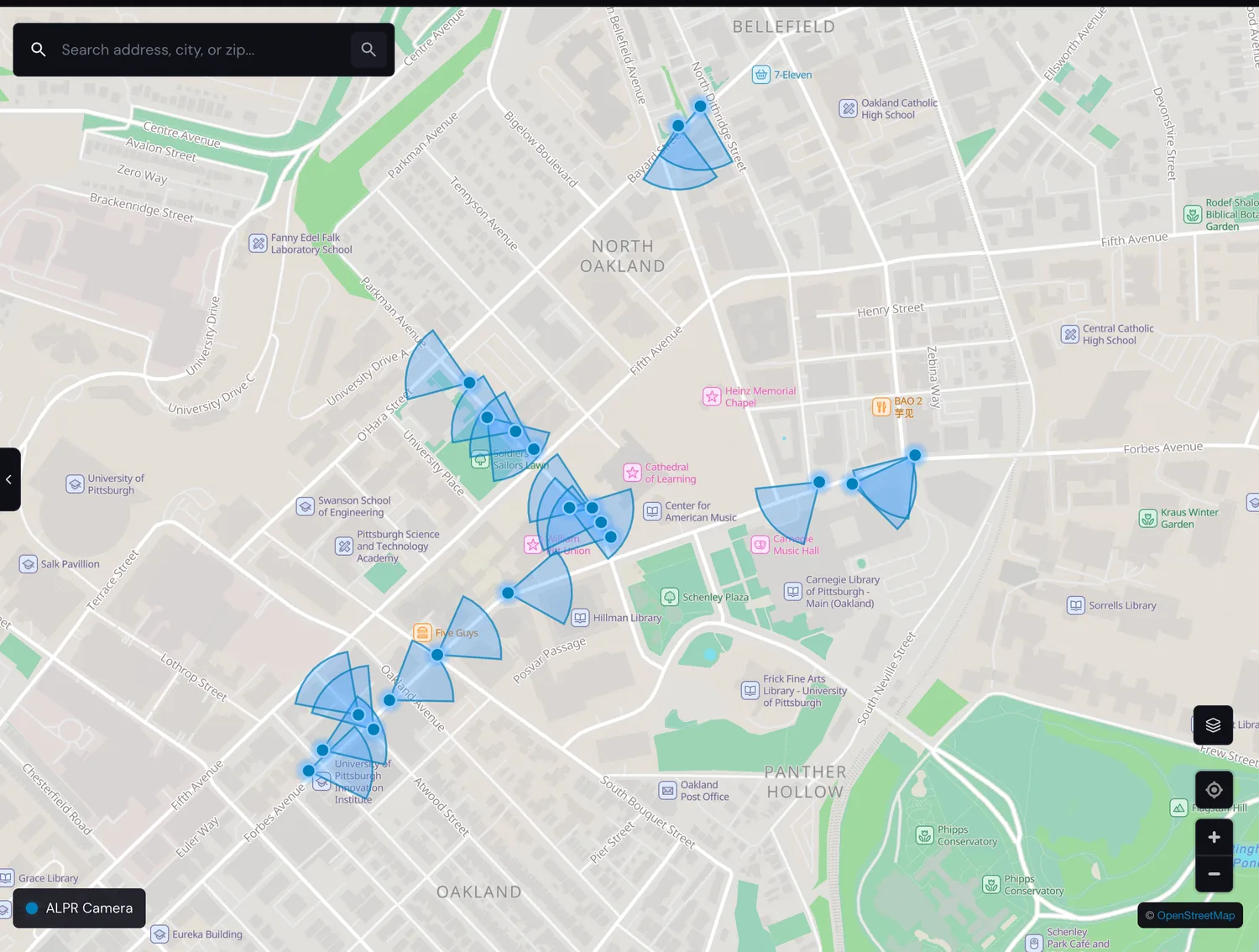
DeFlock map of Oakland showing automated license plate readers ringing the University of Pittsburgh campus
A snapshot of DeFlock’s map over Oakland — each cone marks a logged ALPR and the direction it faces. Map data © OpenStreetMap contributors · ALPR locations via DeFlock · tiles by OpenRoad Labs.
Community map · open data

DeFlock

A crowdsourced map of ALPR locations built on OpenStreetMap, with well over 100,000 cameras documented nationwide. Type in your street, an address, or “Oakland” and see the readers nearby — who makes them and which way they point. Around Pitt, it already shows roughly two dozen readers threaded along the Forbes and Fifth Avenue corridors that cut through campus — a mix of Motorola, Flock, and Genetec. Spot one that isn’t on the map yet? You can add it. The project is run by an activist the EFF represents pro bono, after the largest ALPR vendor tried to shut it down with a trademark claim and backed off.

External research · EFF

Atlas of Surveillance

EFF and the University of Nevada, Reno’s companion map of which police departments run which surveillance tech — ALPRs, face recognition, drones, and more — pieced together from public records and news reports. It’s the bigger picture behind any single camera: who is buying what, and how the data moves between agencies once it’s collected.

And the guardrails are thinner than the pitch suggests. In most departments an officer runs a search with their own login — frequently with no warrant, sometimes without even a case number — and the searches are rarely audited, so the same access that finds a stolen car finds an ex just as easily. That isn’t hypothetical: the Institute for Justice has catalogued at least two dozen cases of officers using Flock and similar readers to stalk partners, exes, and in one instance a stranger — including a Westmoreland County, Pennsylvania officer who pleaded guilty in 2021 to tracking his estranged wife. Almost all of them surfaced only because the person being followed noticed and filed a complaint. The question isn’t whether the data can be misused — it’s who’s checking.

Take action

Ask who’s watching — and on what terms

You’ve seen the national pattern — the fix is to pin down your own department. How long it keeps the reads, who can search them, and whether a warrant is ever required are questions it has to answer, and Pennsylvania’s Right-to-Know Law lets you ask — and put those answers on the record.

Money that can't be frozen

Crypto and the right to protest

Freezing a movement's bank account is one of the oldest ways to shut it down without firing a shot. It happened in Nigeria in 2020: as the #EndSARS protests against police brutality grew, the Feminist Coalition — a group funding protesters' food, medical care, and legal aid — had its bank account and donation link cut off after the central bank leaned on the payment processors. So they asked for Bitcoin instead. It couldn't be frozen, the donations kept coming, and they raised the equivalent of hundreds of thousands of dollars to keep the movement alive. That's the civil-liberties case for cryptocurrency: money the state can't switch off.

The case for it · Censorship-resistance

Uncensorable money

When a government or bank can choke off your funding on demand, a payment rail no one controls is a real form of protection — for protesters, journalists, and dissidents whose accounts are the first thing to get frozen. That's the property that mattered in Nigeria, and in Hong Kong and elsewhere since.

The honest catch · Not the same as privacy

Uncensorable ≠ untraceable

Bitcoin isn't anonymous. Every transaction lives on a public, permanent ledger, and analysis firms routinely tie addresses back to people — the same openness that let the Nigerian donations flow also made the coalition's later spending publicly traceable. If what you need is privacy, not just censorship-resistance, that's a different tool: Monero. We cover it, and how to pay for a VPN with it, on Tools.

Legislation we're following

Real bills on the issues above. We track them and explain them in plain language — we don't tell you how to vote. Follow the links for where each one currently stands.

S. 1318 & related · 119th Congress (federal)

Section 702 of FISA — reauthorization

The authority that lets intelligence agencies collect foreigners' communications without individual warrants — and sweeps up Americans' emails, texts, and calls along with them. The recurring fight: whether agencies must get a warrant before searching that pool for a U.S. person's data.

Track it on congress.gov →
Fourth Amendment Is Not For Sale Act · H.R. 4639 · 118th Congress

Passed the House, stalled in the Senate

The lesson from last Congress. In 2024 the House passed this 219–199, bipartisan — it would have made agencies get a court order instead of buying Americans' location and communications records from data brokers. Then the Senate let it die without a vote. H.R. 8470 puts the same fix back on the table now; for it to survive this time, the Senate has to move too.

Read the bill the House passed (congress.gov) →
HB 78 · Pennsylvania General Assembly (2025–26)

Pennsylvania Consumer Data Privacy Act

Would give Pennsylvanians the right to see, delete, and stop the sale of the personal data companies hold on them — a baseline state privacy law PA doesn't have yet, and the kind of measure our Right-to-Know work runs into constantly.

Track it on palegis.us →

Bills move fast, and numbers reset each session — the links show live status. List current as of July 2026.

Get involved

It’s free, open to everyone at Pitt, and joining takes about a minute.

No dues, no experience needed. Come to a meeting, or leave your name and we’ll tell you when the next one is.